
The Hidden Cost of Not Knowing Your Backlog: Why Ready-Mix Producers Need Better Visibility
Ask a ready-mix concrete producer how much volume they have left to ship this quarter, and you'll often get an estimate rather than an answer. Not because the data doesn't exist — it's usually sitting somewhere between a CRM, a dispatch system, and a spreadsheet someone updates when they get a chance — but because nobody has stitched it together into a single, trustworthy view. That gap between what's been sold and what's actually been delivered is a producer's backlog, and for an industry already dealing with tight margins and unpredictable demand, not seeing it clearly is an expensive blind spot.
Why Concrete Demand Is So Hard to Forecast in the First Place
Ready-mix concrete is uniquely difficult to plan around. Unlike most manufactured goods, it can't be stockpiled — batches typically have a usable window of around 90 minutes before they need to be poured, which means every delivery has to be timed against traffic, site readiness, and weather in near real time.
Layer that on top of demand that swings for reasons largely outside a producer's control — a lender pulling financing, a project pausing for permitting, a cement or aggregate shortage upstream — and forecasting becomes less about predicting the future and more about reacting fast enough when the picture changes. Industry research on the sector consistently points to raw material availability, logistics costs, and weather-driven scheduling disruptions as recurring sources of instability for producers trying to plan capacity and staffing.
The practical effect: a project's volume can slip for reasons that have nothing to do with sales performance, and if nobody is watching closely, that slippage goes unnoticed until the job is already wrapping up.
What "Not Seeing It Clearly" Actually Costs
Most producers have some process for tracking a sales pipeline through to delivery — but "process" often means a patchwork of habits rather than a shared system. Some teams live in spreadsheets. Others rely on memory, sticky notes, or whoever happens to remember a project's details.
That patchwork creates a few predictable problems:
- Static data goes stale fast. A spreadsheet last touched a week ago doesn't reflect a job that just got rescheduled or scaled back.
- Manual entry invites errors. An extra zero or a mistyped digit in a cross-referenced spreadsheet can throw off a volume calculation without anyone noticing until much later.
- Discrepancies pile up across teams. Sales might be working off one quarter's export while finance is working off another, with no way to reconcile the two in real time.
- Revenue gets counted before it's collected. A project quoted at 500 yards that only ships 340 before wrapping up represents revenue that was booked but never delivered — and nobody enjoys walking that back after the fact.
None of this is a people problem. It's a systems problem: the data required to catch these issues early already exists, it's just scattered across tools that don't talk to each other.
What Better Backlog Visibility Looks Like
Solving this doesn't require producers to abandon their existing systems — quoting software, dispatch platforms, and ticketing tools are already generating the data needed. What's missing is a layer that pulls it together and makes it usable. A few characteristics separate a genuinely useful backlog view from another static report:
It updates automatically. If a dashboard requires someone to manually export and refresh it, it's already behind the moment it's built. Real-time visibility means pulling directly from dispatch and ticketing systems as tickets are cut, not on a weekly export schedule.
It shows sold volume against shipped volume, sliced multiple ways. Backlog, at its simplest, is sold minus shipped-to-date. But that number is only actionable when it can be broken down by project, plant, market, or salesperson — because a healthy company-wide number can still hide a plant that's dangerously behind or a single project quietly slipping.
It flags capacity risk, not just delivery risk. A plant can be fully on schedule and still be in trouble if its forecasted volume exceeds what it can realistically produce in a given window. Comparing forecast against plant capacity — not just against what's been shipped — is what turns a reporting tool into an early-warning system.
It accounts for customer behavior, not just volume. Two customers can generate identical revenue and have very different profitability profiles. Metrics like average wait time and unload time at the job site can reveal that a high-volume customer is quietly eating into margin by holding trucks longer than they should — information that's nearly impossible to see in a volume-only spreadsheet.
It captures data regardless of where a job originated. Not every order flows through a formal quoting and project-management workflow — a same-day COD order might be created directly in a dispatch system with no assigned start or end date. A backlog view that only reflects formally tracked projects will systematically undercount real shipped volume.
The Bigger Picture: Backlog as an Early-Warning System
The value of solving this isn't just administrative tidiness. It's the difference between finding out a project is short on volume five days before its deadline — with enough runway to get trucks moving — and finding out after the deadline has already passed, when the only remaining option is an uncomfortable conversation about revenue that has to be walked back.
That shift, from reactive to proactive, is really what backlog visibility is about: giving sales, operations, and finance teams a shared, trustworthy source of truth so they can catch problems while there's still time to fix them, rather than reconstructing what went wrong after the fact.
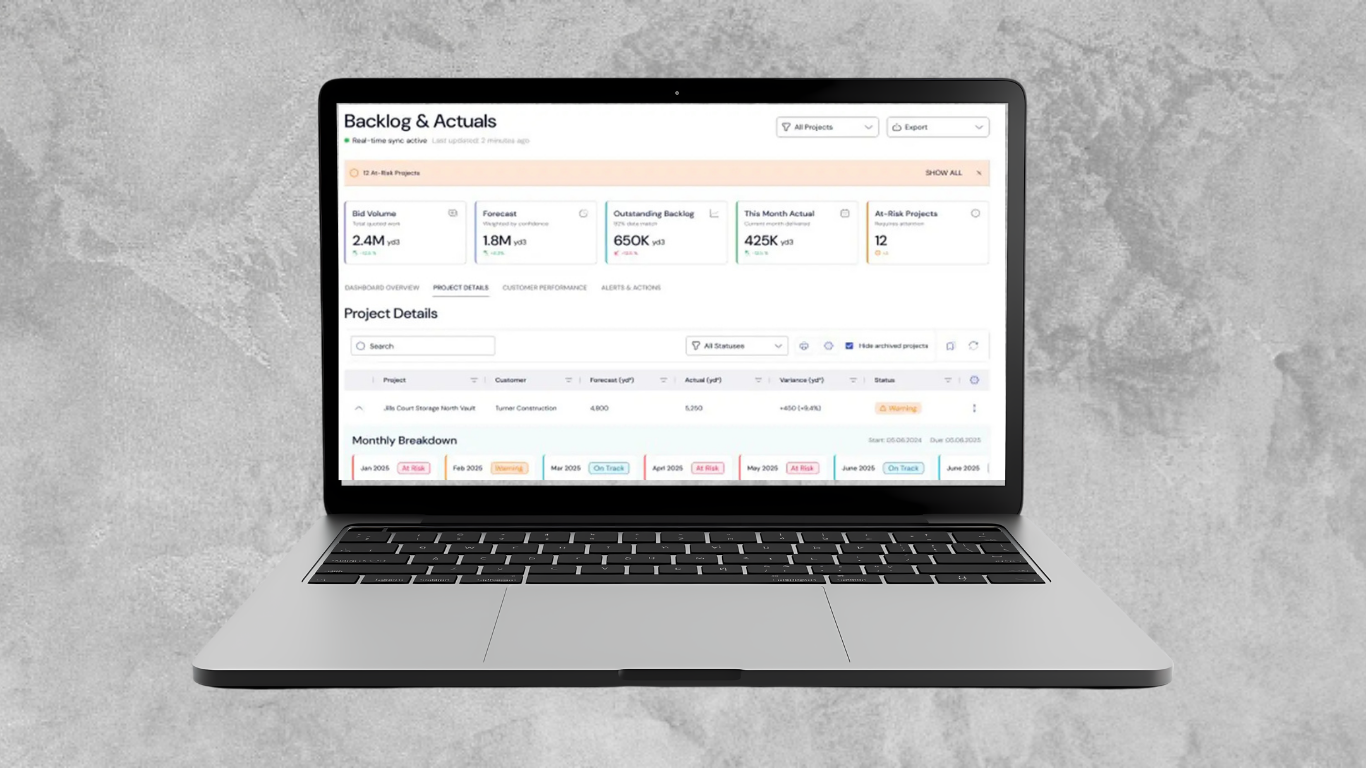
Tools purpose-built for the concrete industry — like Backlog by Slabstack, which connects quoting, forecasting, and dispatch data into a single live dashboard — are one example of how producers are starting to close this gap without adding manual work to already-stretched teams. But whatever the tool, the underlying principle holds for any producer evaluating their own process: if you can't see your backlog clearly today, you're probably finding out about problems later than you'd like.