
When evaluating ready-mix software, most producers naturally focus on the product itself.
They compare features, pricing, implementation timelines, integrations, and day-to-day functionality. While these factors are important, there is another consideration that can have a significant impact on long-term success: software support.
In this article, we'll explore why support should be a key part of any ready-mix software evaluation. We'll discuss how support affects daily operations, the hidden costs of slow response times, the differences between support models, and the questions producers should ask vendors before making a decision.
|
Key takeaways
|
Why software support should be part of the buying decision for producers
Many software evaluations focus on what happens before and during implementation.
Teams evaluate product functionality, compare pricing models, discuss implementation timelines, and review training plans and migration strategies. All of these factors are important, but what often receives less attention is what happens six months, one year, or even five years after implementation.
A ready-mix software is not a one-time purchase; it becomes part of daily operations, so considering ongoing support should be an important decision criterion.
Dispatchers rely on the software to schedule loads, batch operators use it to manage production, drivers depend on it for delivery information, and managers use it to monitor performance and make decisions.
As operations evolve, software users inevitably need ongoing assistance.
For example, a producer may hire a new dispatcher who needs help understanding software, a plant manager may have questions about reporting, or a batching team may need assistance in introducing new production procedures or changing how orders move through the plant.
In each case, support becomes part of the long-term relationship between the producer and the software provider.
Many software companies are highly responsive during the sales process. However, the long-term experience is ultimately shaped by the quality of support available after the contract is signed and implementation is complete.
That is why producers should evaluate support with the same level of scrutiny they apply to software functionality, because it plays an important role in managing a ready-mix concrete plant.
The real cost of downtime in ready-mix operations
The industry commonly uses a figure of $2 per minute for idle time, and that number adds up faster than it seems. For instance, an inability to print tickets for 30 minutes translates to $60 in lost productivity. Similarly, an unresolved batch system fault that drags on overnight can compound into a much larger loss by the time the morning shift starts.
Ready-mix operations also carry a risk that many other industries don't face: a software-related failure can have physical consequences.
Unlike a delayed shipment or a missed email, a batching error or poor timing issue connects directly to the quality of concrete your plant is producing. Bad batching and timing mistakes can affect structural integrity, and that risk makes resolving software issues quickly a matter of operational and physical consequence, too.
The support gap is where this risk costs you money.
- If a vendor's response time runs into hours, which is common with offshore support queues operating across time zones, the cost of downtime keeps climbing while a producer waits for a callback.
- When a critical batching or dispatch issue occurs, operations often can't move forward normally until someone helps resolve the problem.
You can use the $2 figure as a practical benchmark when comparing vendors.
A support team that resolves a batching issue in 15 minutes costs the operation roughly $30 in idle time. A support team that takes three hours to respond pushes that same issue past $300 before anyone even starts working on a fix.
Multiplying that gap across a year of operations shows why response time deserves the same scrutiny as features or pricing during a vendor evaluation.
|
Pro tip: Concrete dispatch software is central to how ready-mix producers manage daily operations. It coordinates customer orders, truck scheduling, batching timelines, and deliveries so dispatchers can keep loads moving efficiently between the plant and job sites. Here are 5 features you should look for when evaluating concrete dispatch software. |
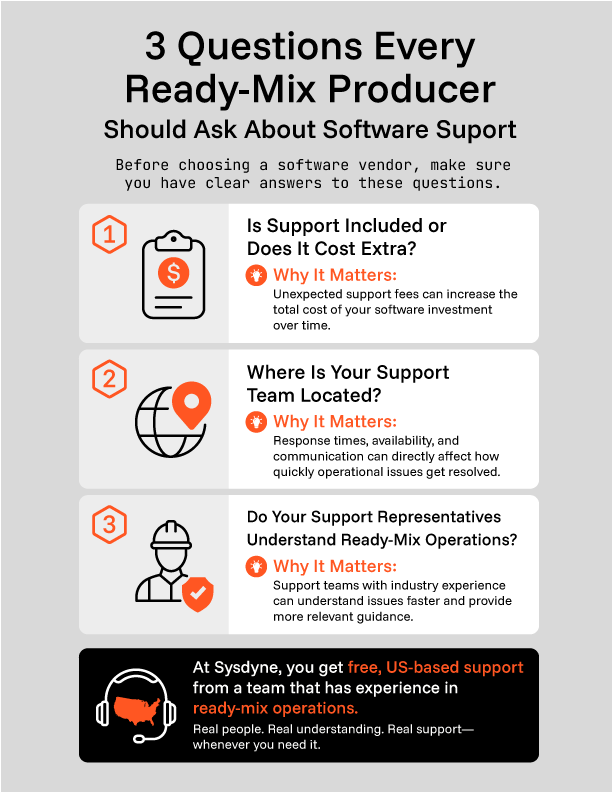
Three questions every producer should ask software vendors about support
Support can be quite tricky to evaluate from a product demonstration alone.
The most effective approach is to ask these direct questions during the evaluation process.
Is support included or does it cost extra?
Support structures vary significantly across software providers.
Some vendors include support as part of the subscription. Others offer multiple service tiers with different response times, capabilities, or coverage levels.
Producers should understand:
- Whether support is included in the first place in the subscription
- If premium support requires additional fees
- What services are covered
- Whether additional training incurs extra costs
- How support costs may change as the business grows / more people are added to the team
Understanding the full cost of ownership helps producers make more informed decisions and avoid unexpected expenses after implementation.
Where is your support team located?
Support location affects response expectations more than most producers realize. A support team operating across several time zones introduces communication challenges, and a producer calling in during a local emergency may end up explaining the same problem to multiple people before reaching someone who can actually help.
Ready-mix operations often start well before sunrise, and a support team that isn't staffed or available during those early hours leaves producers without help exactly when batching and dispatch activity is ramping up.
Producers should ask vendors directly how support coverage maps to a typical ready-mix workday, which often starts before dawn and runs into the evening across multiple shifts.
During vendor evaluations, producers should ask:
- Where support teams are located
- What support hours are available
- How emergency situations are handled
- What response times can be expected
A vendor based in a distant time zone may offer support hours that look reasonable on paper but don't actually overlap with when most issues come up on the batch house floor or in the dispatch booth.
Do your support representatives understand ready-mix operations?
Apart from the location of the support reps, you should also consider whether they have experience in the ready-mix concrete industry.
Technical knowledge and operational knowledge are not the same thing, and the difference shows up the moment a real problem hits the batch house. A support rep can be technically capable of navigating software architecture while still missing the operational context behind a producer's question.
- Industry experience speeds up problem-solving because a rep who has worked in dispatch or batching understands the urgency and the stakes without needing it explained first.
- For instance, a generic software-only support team might treat a tolerance control alert as a routine notification, while someone with ready-mix experience recognizes it as a signal that needs immediate attention before it affects a pour.
This gap matters most during the calls that can't wait.
A producer dealing with a will-call scheduling conflict or a PLC controller error during a live pour needs someone on the other end of the line who already understands what those terms mean and what's at stake operationally.
Explaining ready-mix fundamentals to a support rep before getting to the actual problem wastes time that a producer doesn't have in the middle of a pour window.
How Sysdyne approaches after-sales support differently
When producers evaluate software support, they are ultimately evaluating the quality of the long-term partnership they will receive after implementation.
Sysdyne has built its support model around the needs of ready-mix producers and the realities of daily operations. Here’s how.
1. Support is included as part of the subscription
You don’t need to navigate multiple support tiers or purchase premium support packages to access assistance. Support is offered as part of your Sysdyne subscription because we consider it a core component of the customer experience and an important part of helping customers achieve long-term success with the software.
2. Sysdyne's support team is US-based
This approach helps facilitate communication and allows support personnel to work closely with producers who operate in time-sensitive environments.
Support is available around the clock, helping producers access assistance whenever operational issues arise.
3. Support reps have industry experience
A significant portion of our support team comes from within the ready-mix industry. Many have worked in the same operational environments they now support. They understand dispatch workflows, batching processes, delivery challenges, and the pressures producers face every day.
That experience helps create more productive conversations because you don’t need to spend time explaining the fundamentals of their operations.
Support extends across the entire Sysdyne platform, including:
4. Anyone can contact support
Anyone on the producer's team can contact support directly. Assistance is not limited to a single administrator or designated contact. Dispatchers, batch operators, managers, and other users can reach out whenever they need help.
That approach supports the reality of ready-mix operations, where issues often surface on the plant floor, in the dispatch office, or during active deliveries.
Here’s how one of our customers, Croell, Inc sums up Sysdyne’s support:
“By far the best part of our switch to Sysdyne has been the customer service. No other company comes close to their responsiveness and assistance when you have a question or request.”
Read more Sysdyne case studies.
Or, simply get in touch with our team to see how you can implement Sysdyne’s products at your plant and improve your profit margins.
Frequently asked questions
1. Why is software support important for ready-mix producers?
Software support helps producers resolve issues quickly, minimize downtime, and keep dispatch, batching, and delivery operations running smoothly. Strong support also helps teams get more value from their software over time.
2. What should I look for in a ready-mix software support team?
Look for a support team that understands ready-mix operations, offers timely assistance, communicates clearly, and is available when your team needs help. Industry experience can be especially valuable when resolving operational issues.
3. Is software support typically included with ready-mix software?
It depends on the vendor. Some providers include support as part of the subscription, while others offer different support tiers or charge additional fees for certain services. It is important to understand exactly what is included before signing a contract.
4. What should producers know about dispatching solutions support before choosing a vendor?
Dispatching solutions support should include timely assistance, knowledgeable representatives, and access to help when operational issues arise. Producers should ask how support requests are handled, what response times to expect, and whether support staff understand ready-mix dispatch workflows and scheduling challenges.
5. How long should software vendors provide support after implementation?
Support should continue throughout the life of the software relationship. Producers often need assistance months or years after implementation as employees change, operations evolve, and new business requirements emerge.